Skip to content

Networking

CKA Road Trip: Kubernetes Health Endpoints

Every major Kubernetes component exposes HTTP endpoints you can curl to check if it's alive. Useful when kubectl isn't working and you need to verify what's actually running.


The Endpoints

# apiserver
curl -k https://localhost:6443/healthz
curl -k https://localhost:6443/livez
curl -k https://localhost:6443/readyz
curl -k https://localhost:6443/readyz?verbose   # shows each check by name

# kubelet
curl -k https://localhost:10250/healthz

# scheduler
curl -k https://localhost:10259/healthz

# controller-manager
curl -k https://localhost:10257/healthz

# etcd — needs certs
curl -k https://localhost:2379/health \
  --cert /etc/kubernetes/pki/etcd/server.crt \
  --key /etc/kubernetes/pki/etcd/server.key \
  --cacert /etc/kubernetes/pki/etcd/ca.crt

All return ok when healthy.

/readyz?verbose is the most useful — shows each individual check:

[+] ping ok
[+] etcd ok
[+] poststarthook/start-informers ok
[-] some-check failed   ← tells you exactly what's wrong

Where to Run These From

This is the part that trips people up. localhost means different things depending on where you are.

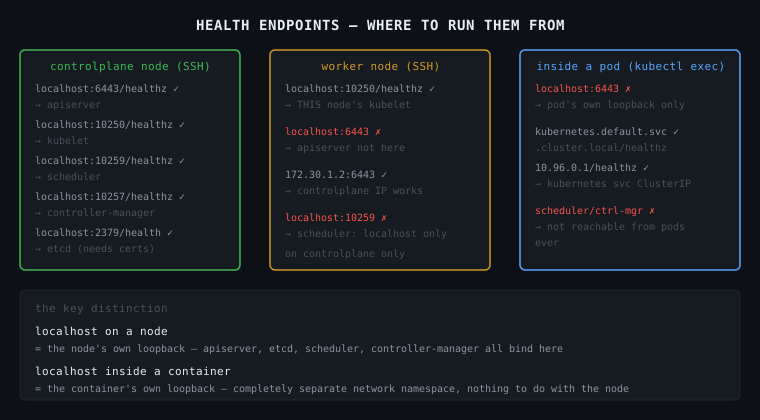
From the controlplane node (SSH'd in)

You are on the Linux host. localhost here is the node itself.

ssh controlplane

curl -k https://localhost:6443/healthz      # reaches apiserver ✓
curl -k https://localhost:10250/healthz     # reaches kubelet ✓
curl -k https://localhost:10259/healthz     # reaches scheduler ✓
curl -k https://localhost:10257/healthz     # reaches controller-manager ✓
curl -k https://localhost:2379/health ...   # reaches etcd ✓

All components run on the controlplane node, so localhost works for all of them.

From a worker node (SSH'd in)

You are on a different Linux host. The apiserver, etcd, scheduler, controller-manager are NOT here.

ssh node01

curl -k https://localhost:10250/healthz     # reaches THIS node's kubelet ✓
curl -k https://localhost:6443/healthz      # FAILS — apiserver not on this node ✗
curl -k https://172.30.1.2:6443/healthz    # works — using controlplane IP ✓

From inside a pod (kubectl exec)

This is the most confusing one. When you kubectl exec into a pod, you are inside a container. That container has its own network namespace — its own localhost, its own loopback. It is completely separate from the node's network.

kubectl exec -it some-pod -- /bin/sh

# inside the container:
curl localhost:6443       # FAILS — localhost here is the container, not the node
curl localhost:10250      # FAILS — same reason

# to reach the apiserver from inside a container:
curl -k https://kubernetes.default.svc.cluster.local/healthz   # ✓
curl -k https://10.96.0.1/healthz                               # ✓ (kubernetes service ClusterIP)

# scheduler and controller-manager — NOT reachable from pods at all
# they only bind to localhost on the controlplane node, intentionally

Why scheduler and controller-manager are localhost-only

They don't need to accept connections from anything except the apiserver, and the apiserver talks to them on the same node. Binding to an external interface would expose them unnecessarily. So they listen on 127.0.0.1 only — unreachable from pods or other nodes.


The Mental Model

controlplane node
  127.0.0.1:6443    ← apiserver    (also on node IP — reachable from anywhere)
  127.0.0.1:10250   ← kubelet      (also on node IP)
  127.0.0.1:10259   ← scheduler    (localhost ONLY)
  127.0.0.1:10257   ← controller-manager (localhost ONLY)
  127.0.0.1:2379    ← etcd         (localhost ONLY)

worker node
  127.0.0.1:10250   ← kubelet (its own kubelet)

pod/container
  127.0.0.1         ← the container itself, nothing else
  10.96.0.1         ← kubernetes service → routes to apiserver

The key distinction: localhost inside a container is the container's own loopback. It has nothing to do with the node it's running on.
697

CKA Road Trip: Kubernetes Networking — From the Ground Up

Kubernetes networking is confusing because there are multiple layers of "network" stacked on top of each other. Once you understand each layer and what it owns, it stops being magic.


Layer 0 — The Linux Host Network

Before Kubernetes exists, you have a Linux machine with a network interface:

controlplane node
  eth0: 172.30.1.2     ← the real IP of this machine
  lo:   127.0.0.1      ← loopback, local to this machine only

This is the node network. Machines talk to each other here. 172.30.1.2 is reachable from node01 at 172.30.2.2. Normal networking.


Layer 1 — Linux Network Namespaces

This is where containers come in. When a container starts, the kernel creates a network namespace for it. Think of a network namespace as a completely separate, isolated copy of the networking stack.

Inside a network namespace: - its own network interfaces - its own IP address - its own routing table - its own loopback (127.0.0.1)

The container has no idea the host network exists. Its localhost is its own loopback, not the node's.

host network namespace          container network namespace
  eth0: 172.30.1.2               eth0: 192.168.1.5  ← pod IP
  lo:   127.0.0.1                lo:   127.0.0.1     ← container's OWN loopback

These are two completely separate localhostes. This is the source of most networking confusion.


Layer 2 — The veth Pair (The Wire)

A container in its own namespace can't talk to anything. It needs a wire connecting it to the outside world.

That wire is a veth pair — two virtual network interfaces connected like a cable. What goes in one end comes out the other.

host side                    container side
  veth_abc123  ←──────────→  eth0 (inside container)
  (on the bridge)              (pod IP: 192.168.1.5)

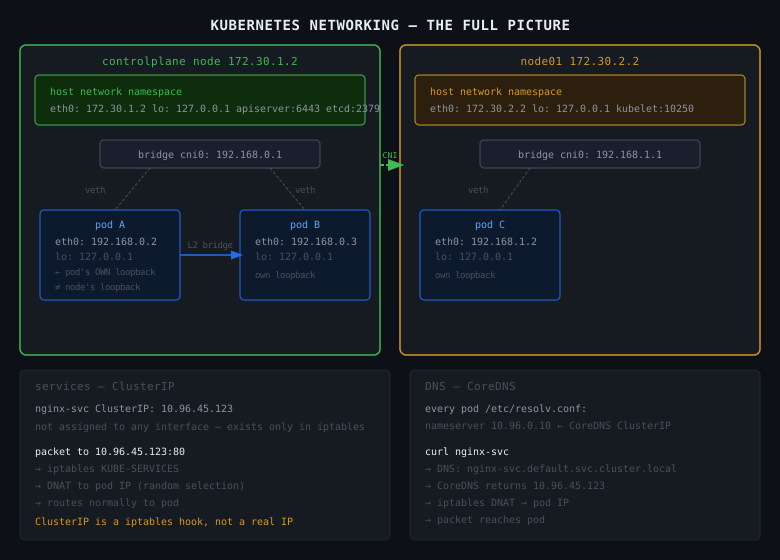
The host end plugs into a bridge (think: a virtual network switch). The container end is the pod's eth0. Every pod gets one veth pair.


Layer 3 — The Bridge (The Switch)

The bridge connects all the veth pairs on a node. Pods on the same node talk through the bridge.

         bridge (cni0: 192.168.1.1)
         /            \
   veth_pod_A      veth_pod_B
       |                |
   pod A             pod B
192.168.1.2      192.168.1.3

Pod A pings Pod B: 1. Pod A sends packet to 192.168.1.3 2. Goes through veth_pod_A to the bridge 3. Bridge forwards to veth_pod_B 4. Pod B receives it

No iptables, no routing — pure L2 switching on the same node.


Layer 4 — Pod IPs (Cross-Node)

Pods on different nodes need to reach each other too. The CNI plugin (Flannel, Cilium, Calico) handles this.

Each node gets a block of pod IPs:

controlplane: pods get 192.168.0.0/24
node01:       pods get 192.168.1.0/24

Cross-node traffic goes through the CNI plugin — either encapsulated in a tunnel (Flannel VXLAN) or routed directly (Calico BGP). The pod doesn't know or care. It just sends to the destination pod IP and the CNI handles getting it there.

Key point: every pod in the cluster gets a unique IP. Any pod can reach any other pod directly by IP — no NAT, no port mapping needed. This is the Kubernetes networking model.


Layer 5 — Services and ClusterIP

Pod IPs are ephemeral. A pod dies, its IP is gone. A new pod gets a new IP. You can't hardcode pod IPs.

A Service gives you a stable IP that never changes. It's called a ClusterIP.

nginx-service   ClusterIP: 10.96.45.123:80
              load balances to:
                pod-A: 192.168.1.2:80
                pod-B: 192.168.1.3:80

But here's the thing — the ClusterIP is not assigned to any interface. You can't ping it. It exists only as an iptables rule written by kube-proxy on every node.

When a pod sends traffic to 10.96.45.123:80: 1. Packet hits the iptables KUBE-SERVICES chain 2. iptables randomly picks a pod IP (load balancing) 3. DNAT rewrites the destination to the pod IP 4. Packet routes normally to the pod

The ClusterIP is just a hook in iptables. That's it.


Layer 6 — DNS

Nobody remembers 10.96.45.123. DNS maps service names to ClusterIPs.

Every pod has /etc/resolv.conf pointing at CoreDNS:

nameserver 10.96.0.10      ← CoreDNS ClusterIP
search default.svc.cluster.local svc.cluster.local cluster.local

When a pod does curl nginx-service: 1. DNS lookup: nginx-service → resolves to nginx-service.default.svc.cluster.local 2. CoreDNS returns 10.96.45.123 3. Pod sends to 10.96.45.123 4. iptables DNAT → pod IP 5. Packet reaches the pod


The localhost confusion — fully explained

Now that you understand network namespaces:

controlplane node (host namespace)
  127.0.0.1:6443  ← apiserver listening here

pod on that node (its own namespace)
  127.0.0.1       ← the pod's OWN loopback
                    completely separate from the node's loopback

When you kubectl exec into a pod and run curl localhost:6443 — you are inside the pod's network namespace. Its localhost is its own loopback. The apiserver is on the node's loopback, which is a completely different network namespace. The packet never leaves the pod's namespace, never reaches the node, never reaches the apiserver.

To reach the apiserver from inside a pod:

# use the kubernetes service — this IS reachable from any pod
curl -k https://kubernetes.default.svc.cluster.local/healthz
# or
curl -k https://10.96.0.1/healthz   # kubernetes service ClusterIP

This works because 10.96.0.1 is a ClusterIP — iptables on the node rewrites it to the apiserver's actual IP and port.


The Full Picture

                    ┌─────────────────────────────────┐
                    │         controlplane node         │
                    │  eth0: 172.30.1.2  (node IP)     │
                    │  lo:   127.0.0.1   (node loopback)│
                    │    apiserver: 127.0.0.1:6443      │
                    │    etcd:      127.0.0.1:2379      │
                    │                                   │
                    │  ┌─────────────┐                  │
                    │  │   pod A     │ ← own namespace  │
                    │  │ 192.168.0.2 │                  │
                    │  │ lo:127.0.0.1│ ← pod's loopback │
                    │  └──────┬──────┘                  │
                    │      veth pair                    │
                    │      bridge cni0                  │
                    └─────────────────────────────────┘
                              │ cross-node via CNI
                    ┌─────────────────────────────────┐
                    │           node01                  │
                    │  eth0: 172.30.2.2                 │
                    │  ┌─────────────┐                  │
                    │  │   pod B     │                  │
                    │  │ 192.168.1.3 │                  │
                    │  └─────────────┘                  │
                    └─────────────────────────────────┘

services (ClusterIP) — exist only as iptables rules, on every node
DNS (CoreDNS)        — a pod, reachable via its own ClusterIP 10.96.0.10

The Rules Worth Memorising

Pod to pod (same node): direct via bridge — no NAT, no routing.

Pod to pod (different node): CNI handles it — pod just sends to the pod IP.

Pod to service: iptables DNAT on the node — ClusterIP gets rewritten to a pod IP.

Pod to apiserver: use kubernetes.default.svc.cluster.local — never localhost.

Node to component: localhost works — you're on the same host.

localhost inside a container: the container's own loopback only — nothing else.

697

Linux Networking From Zero — The 4 Things You Need to Understand Kubernetes Networking

Before Kubernetes. Before containers. Just Linux.

If you understand these 4 things, Kubernetes networking stops being magic and becomes obvious. If you don't, no amount of Kubernetes articles will help.


1. The Network Interface

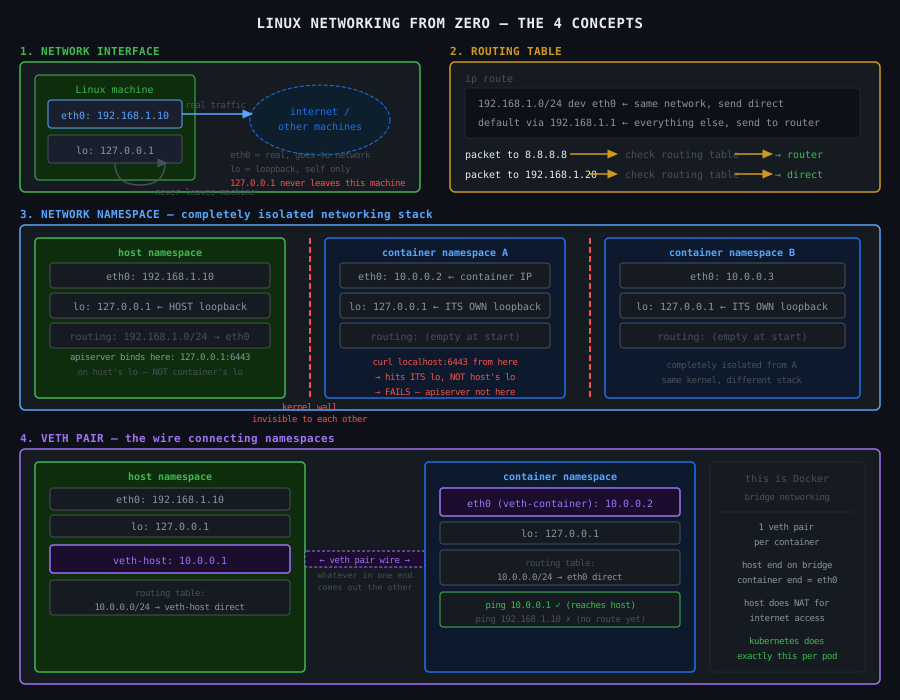
A network interface is how a machine sends and receives data on a network. Think of it as a socket in the wall — the physical plug point between your machine and the outside world.

On a Linux machine:

ip a
# 1: lo: <LOOPBACK>
#    inet 127.0.0.1/8
# 2: eth0: <BROADCAST,MULTICAST,UP>
#    inet 192.168.1.10/24

Two interfaces here:

eth0 — the real network interface. Has IP 192.168.1.10. This is how this machine talks to other machines. Data going out leaves through eth0. Data coming in arrives through eth0.

lo — the loopback interface. Has IP 127.0.0.1. This is special — it never leaves the machine. It's a self-addressed envelope. When you curl localhost, the packet goes into lo and comes straight back out to the same machine. No network cable involved. Nothing leaves.

This is critical. 127.0.0.1 and localhost are not "the machine" in an abstract sense. They are specifically the loopback interface lo. Traffic sent to 127.0.0.1 goes to lo and stays on that machine. It cannot reach any other machine. It cannot be seen by any other machine.


2. The Routing Table

When your machine wants to send a packet, it needs to know where to send it. The routing table is the map it uses to make that decision.

ip route
# default via 192.168.1.1 dev eth0
# 192.168.1.0/24 dev eth0 proto kernel scope link

Two rules here:

192.168.1.0/24 dev eth0 — any packet going to an IP in the range 192.168.1.0 to 192.168.1.255 — send it out through eth0 directly. These machines are on the same network. No middleman needed.

default via 192.168.1.1 dev eth0 — any packet going anywhere else — send it to 192.168.1.1 (the router/gateway) through eth0. The router knows where to forward it from there.

The machine checks the routing table top to bottom, picks the first rule that matches the destination IP, and sends the packet out through the specified interface.

If no rule matches and there's no default — the packet is dropped. The machine has no idea where to send it.

The key point: the routing table is per-machine. Every machine has its own. Every container has its own. This is why networking breaks when routing tables are wrong or missing.


3. The Network Namespace

Here is where containers start making sense.

A network namespace is a completely isolated copy of the entire Linux networking stack. Not a different machine — the same kernel — but a completely separate set of:

  • network interfaces
  • routing tables
  • iptables rules
  • port bindings

When you create a new network namespace, it starts with nothing. No interfaces except a DOWN loopback. No routes. Empty iptables. No way to reach anything.

# create a new network namespace called "myns"
ip netns add myns

# run a command inside it
ip netns exec myns ip a
# 1: lo: <LOOPBACK>  ← only loopback, and it's DOWN
#    inet 127.0.0.1/8

ip netns exec myns ip route
# (empty — no routes at all)

From inside myns, you cannot reach the internet. You cannot reach the host. You cannot reach anything. It is completely empty.

From the host, myns doesn't exist on the network at all. The host's eth0 has no idea myns is there.

This is what a container is. When Docker or containerd creates a container, it creates a new network namespace. The container's process runs inside that namespace. It gets its own interfaces, its own routing table, its own 127.0.0.1. The host's network is completely invisible to it.

This is why localhost inside a container is the container's own loopback — not the host's. The container is in a different network namespace. It has its own lo. The host's lo is in a different namespace entirely.


4. The veth Pair

A network namespace starts isolated. To make it useful, you need to connect it to something. That connection is a veth pair.

A veth pair is two virtual network interfaces linked together like a pipe. Whatever you send into one end comes out the other end. They always come in pairs — you cannot have just one.

# create a veth pair: veth-host and veth-container
ip link add veth-host type veth peer name veth-container

# currently both ends are on the host
ip a | grep veth
# veth-host
# veth-container

# move veth-container into the namespace
ip link set veth-container netns myns

# now:
# veth-host      → on the host
# veth-container → inside myns namespace

# configure the host end
ip addr add 10.0.0.1/24 dev veth-host
ip link set veth-host up

# configure the container end
ip netns exec myns ip addr add 10.0.0.2/24 dev veth-container
ip netns exec myns ip link set veth-container up
ip netns exec myns ip link set lo up

# test
ip netns exec myns ping 10.0.0.1   # namespace pings host end ✓
ping 10.0.0.2                       # host pings namespace ✓

The namespace now has connectivity — but only to the host end of the veth pair. Not the internet. Not other namespaces. Just the one wire you gave it.

This is exactly what Docker does for every container. One veth pair per container. One end on the host, one end inside the container's network namespace. The container calls its end eth0.


How These 4 Things Connect

Start from nothing and build up:

Step 1 — bare machine:

eth0: 192.168.1.10   ← real interface, talks to the world
lo:   127.0.0.1      ← loopback, stays on this machine
routing table tells packets which interface to use

Step 2 — create a network namespace:

host namespace         new namespace (myns)
  eth0: 192.168.1.10     lo: 127.0.0.1 (DOWN)
  lo:   127.0.0.1        (nothing else)

myns is completely isolated — no way in or out

Step 3 — add a veth pair:

host namespace              myns namespace
  eth0: 192.168.1.10          eth0: 10.0.0.2  ← veth-container renamed
  lo:   127.0.0.1             lo:   127.0.0.1
  veth-host: 10.0.0.1 ←──→ veth-container: 10.0.0.2

myns can now talk to the host via the veth pair
myns still cannot reach the internet

Step 4 — add routing + NAT for internet access:

host enables IP forwarding
host adds NAT rule: traffic from 10.0.0.0/24 → masquerade as 192.168.1.10

myns adds default route: all traffic → via 10.0.0.1 (the host end)

now myns can reach the internet through the host

This is a Docker container with bridge networking. Every container is a network namespace connected to the host via a veth pair, with the host doing NAT to give it internet access.


The 5 Things to Remember

A network interface is how a machine connects to a network. eth0 is real. lo is loopback — never leaves the machine.

The routing table decides where each packet goes based on the destination IP. No route = packet dropped.

A network namespace is a completely isolated networking stack. Its own interfaces, routes, iptables, and its own 127.0.0.1. What happens in a namespace stays in that namespace.

A veth pair is the wire connecting two namespaces. Always two ends. Move one end into a namespace, the other stays on the host.

localhost inside a container is the container's own loopback in its own namespace. It is not the host's loopback. They share a kernel but not a network namespace.

697